
Forward Proxy vs Reverse Proxy
Same word, two completely different jobs. Here’s a clean mental model.
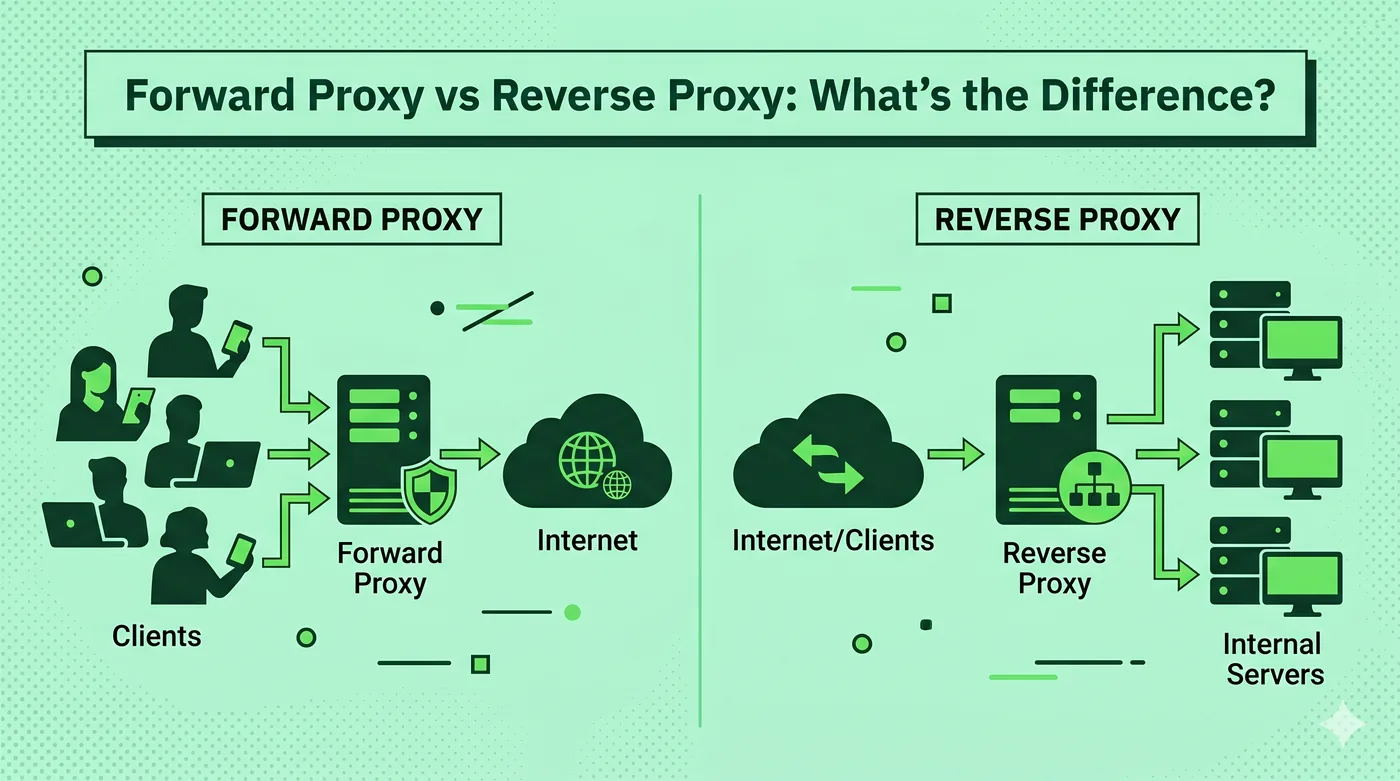
A forward proxy sits in front of clients and forwards their requests out to the internet. A reverse proxy sits in front of servers and forwards incoming requests in to them. Forward proxies protect clients; reverse proxies protect and accelerate servers.
Key takeaways
- Forward proxy = on the user’s side; reverse proxy = on the server’s side.
- Forward proxies are used for filtering, caching, and IP masking.
- Reverse proxies handle TLS termination, load balancing, and DDoS mitigation.
- A single network can use both at the same time.
The two-second mental model
Imagine a building with a receptionist at the front desk. If the receptionist makes calls on behalf of people inside the building, they are a forward proxy. If they receive calls from the outside and route them to the right office, they are a reverse proxy. Same person, opposite direction.
Forward proxies in the wild
Schools and offices use them to filter content, cache popular files, and monitor usage. Web-scraping operations use rotating forward proxies to spread requests across many IPs. Some VPNs are technically forward proxies with encryption added.
Reverse proxies in the wild
Almost every modern website sits behind one. Nginx, HAProxy, and Cloudflare are common examples. They terminate HTTPS, balance load across servers, cache responses, and provide a single defensive boundary against the open internet.
Common confusion
‘Proxy’ in casual conversation almost always means a forward proxy. ‘Edge’ or ‘gateway’ usually implies a reverse proxy. CDN edges are a specialised type of reverse proxy.
Frequently asked questions
Is a CDN a reverse proxy?
Yes — a CDN is a globally distributed reverse-proxy and cache.
Can a single server be both?
Yes, larger deployments sometimes run both roles, often on different ports.
Is a load balancer a reverse proxy?
Most modern load balancers are reverse proxies. The terms overlap heavily.
Sources & further reading
We cite primary sources whenever possible. Below is the reference list relevant to this category. Specific facts in this article are checked against vendor documentation and the sources we link to inline.
Related guides
Residential vs Datacenter Proxies: Honest Comparison
What each one is, what they’re actually used for, and the ethical lines that matter.
Read article → Proxy ServersSOCKS5 vs HTTP Proxies: Use Cases for Developers
When to reach for SOCKS5 and when an HTTP proxy is the better tool.
Read article → Proxy ServersHow Businesses Use Proxies for Legitimate Web Data Collection
Price comparison, SEO, brand protection — and how to do it without breaking rules.
Read article →